
Workshop
A working session that teaches your staff and volunteers to shoot video worth using, on the phones and cameras you already own. Built for nonprofits, and taught first to volunteers in rural India.
Up to 12
Participants from your team
On site
We come to you, travel included
Your own gear
Taught on what your team already has
The Field Deck
Everyone leaves with one
The problem
Your staff and volunteers are in rooms a hired crew will never be in. They see things nobody can schedule. They also have a camera in their pocket that shoots better than what we used professionally ten years ago.
What usually goes wrong is not bad footage. It is no footage, because somebody decided they were not good enough at this yet. Or footage that sits on a card because nobody knew what it was for when they shot it.
Neither of those is a gear problem. Both of them are decisions, and decisions can be taught in a day.
What we cover
01
What separates a story from information, and why the difference decides whether anyone gives.
02
Five answers that every scene, question and shot has to get past.
03
People forgive a soft image. They will not sit through audio they have to strain to hear.
04
Framing is not about looking pretty. It is deciding where the viewer looks.
05
Mostly about where you put people, not what you own. A window does most of the work.
06
The first answer is never the real answer. How to get to the third one without pushing.
07
Shoot it so whoever edits it can actually use it.
08
Every organization has a story it cannot tell the obvious way. You know the ethics already. This is the craft of it.
What everyone leaves with
Twenty-one cards on a ring. Everything worth deciding before you press record, in a form somebody can keep in a pocket and pull out on location.
The Story Compass. The Dignity Check. The Magic Wand questions for getting past a rehearsed answer. The Five-Shot Method. The spin test for finding where the chair goes. One card is the whole day compressed into six things, for anyone who only keeps one.
The deck is not sold separately. Taking the workshop is the only way to get it.
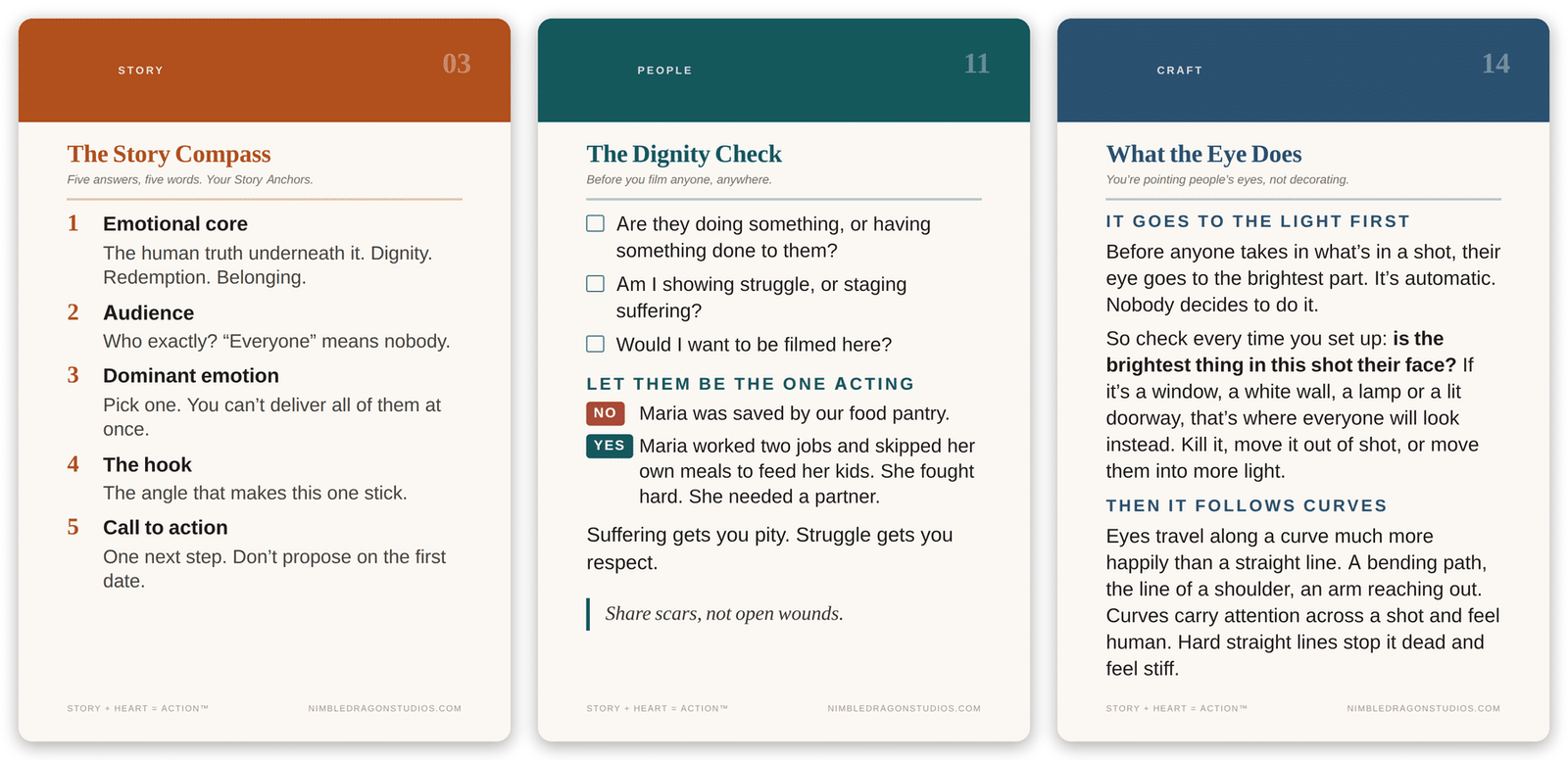
Sample cards from the Field Deck
Where it came from
In March 2025, PRASAD flew us to India to film the work of PRASAD Chikitsa. Their staff and volunteers are on the ground every day, watching things no visiting crew can schedule. They had phones. What they did not have was a way to decide what was worth capturing before they pressed record.
So we built them a workshop and taught it there. PRASAD funded that trip, which makes them the first organization to pay for this session, a year before it had a price on it.
The deck came afterward. We watched which parts people kept and which parts they lost once the day was over, and built the cards around the gap. Nobody remembers a whole day of training. That is not a failure of the training. It is the reason the cards exist.
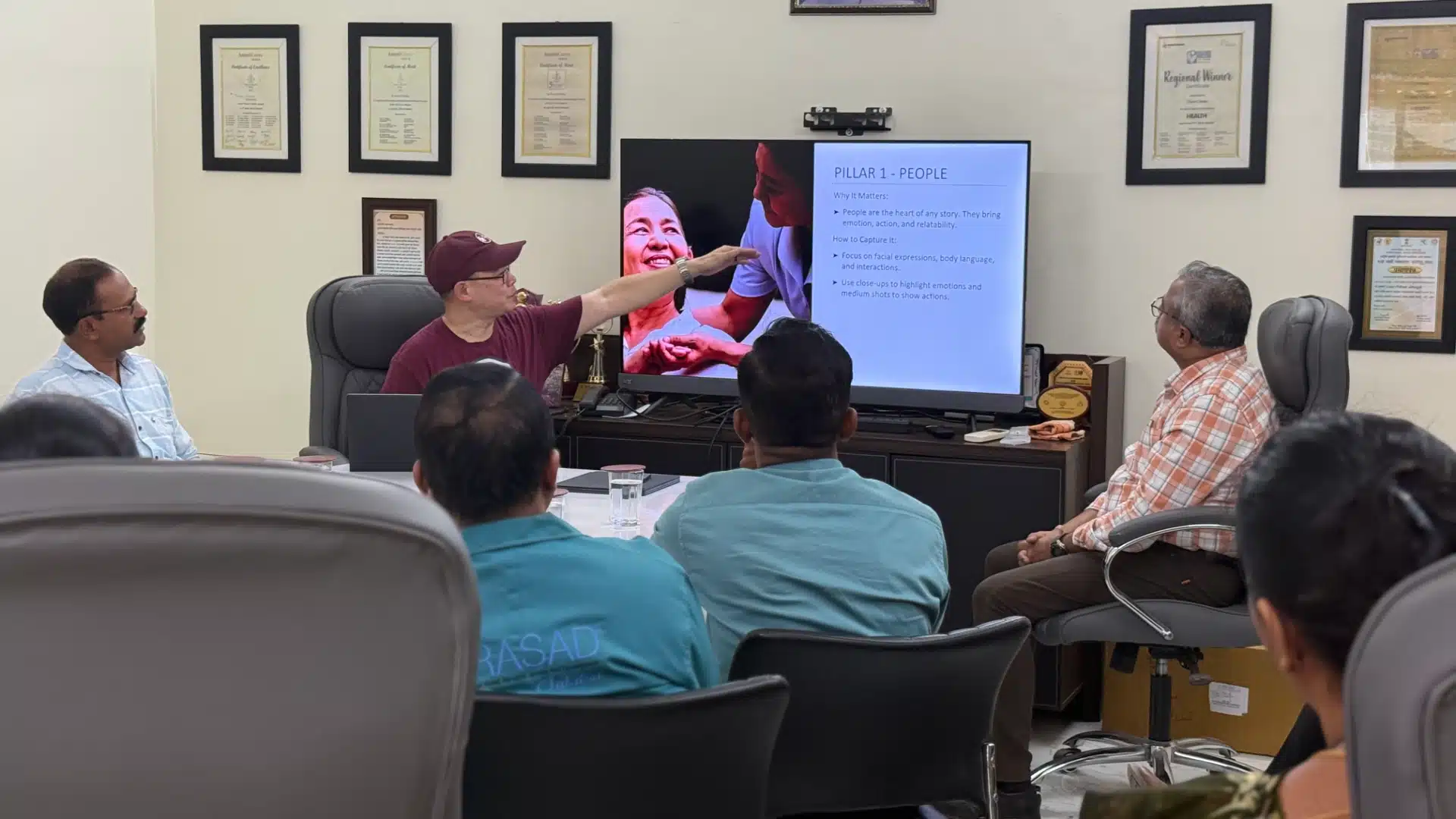
The first workshop. PRASAD staff and volunteers, Ganeshpuri, India, March 2025
The math
Most nonprofits we work with are used to spending $500 to $1,500 on a video. Do that ten times and you have spent $10,000. If none of those ten moved anyone to give, that is $10,000 that bought nothing.
One film done properly at $8,000 costs less than that, because it works.
The workshop sits underneath both. It is one day that changes what your team does every time they pick up a camera, and it keeps working long after the day is over.
What it costs
$2,000
Half day, on site
The workshop.
$3,200
Full day, on site
The workshop, plus an afternoon putting it to work on a real subject with your own people.
Both include travel and up to twelve participants. Everyone leaves with the Field Deck.
We publish these numbers because most people in this line of work do not, and the reason they do not is that the figure moves depending on who is asking. Ours does not. This is a fixed session: same day, same curriculum, same deck, whoever books it.
Production work is quoted by scope, because the scope genuinely changes. A price for that would be a guess. A price for this is just the price.
Questions
Tell us who would be in the room and what your organization keeps needing video for. We will tell you whether a half day or a full day makes more sense.
Most of these begin as a fifteen-minute call.
Last updated September 2026 · Nimble Dragon Studios · Monticello, New York