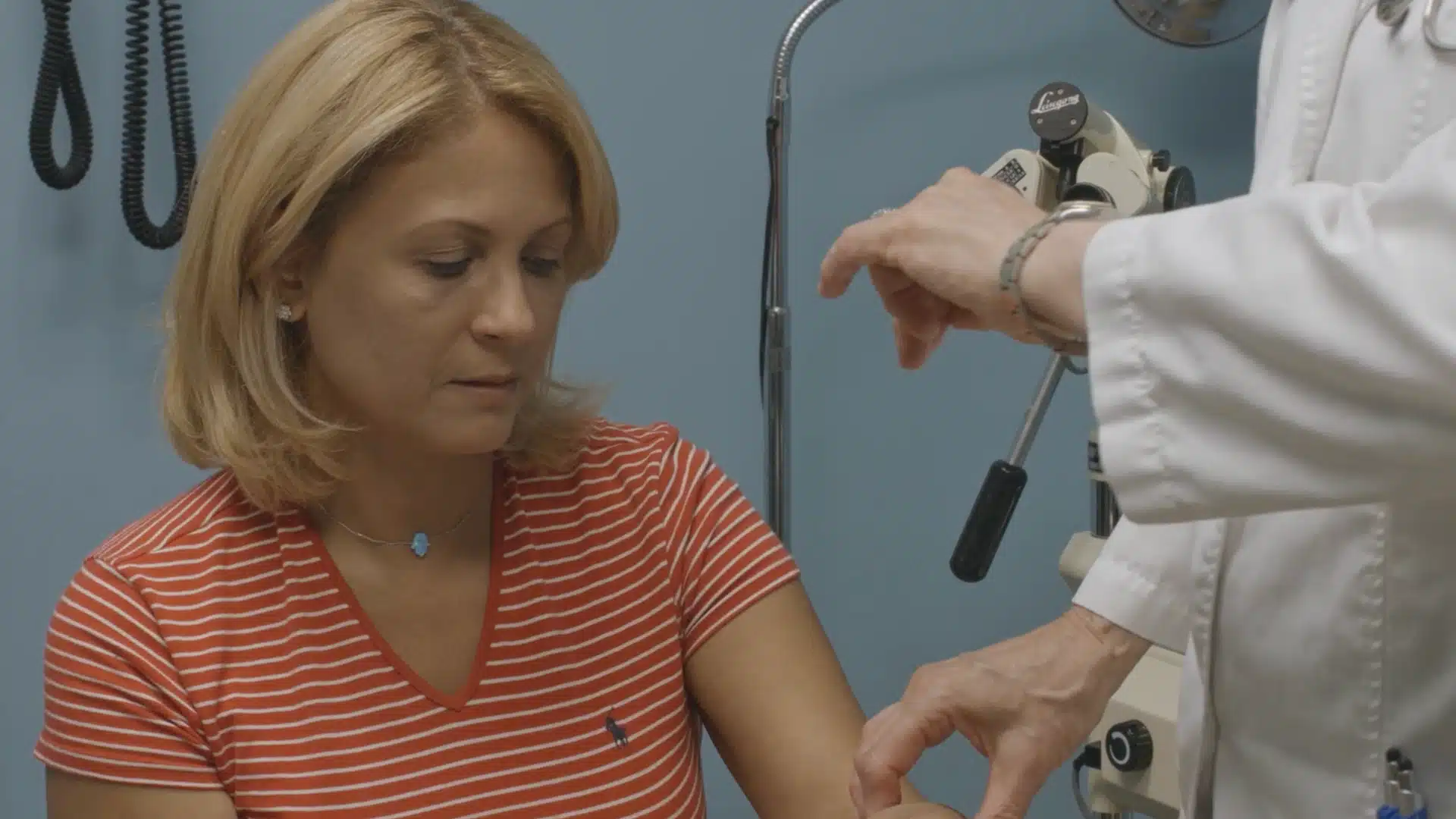
How to Make a Fundraising Video When You Can’t Film the People You Serve
Most advice about nonprofit video assumes you can film the people you help. Find the right person, sit them down, let them tell their story. It is good advice. It…

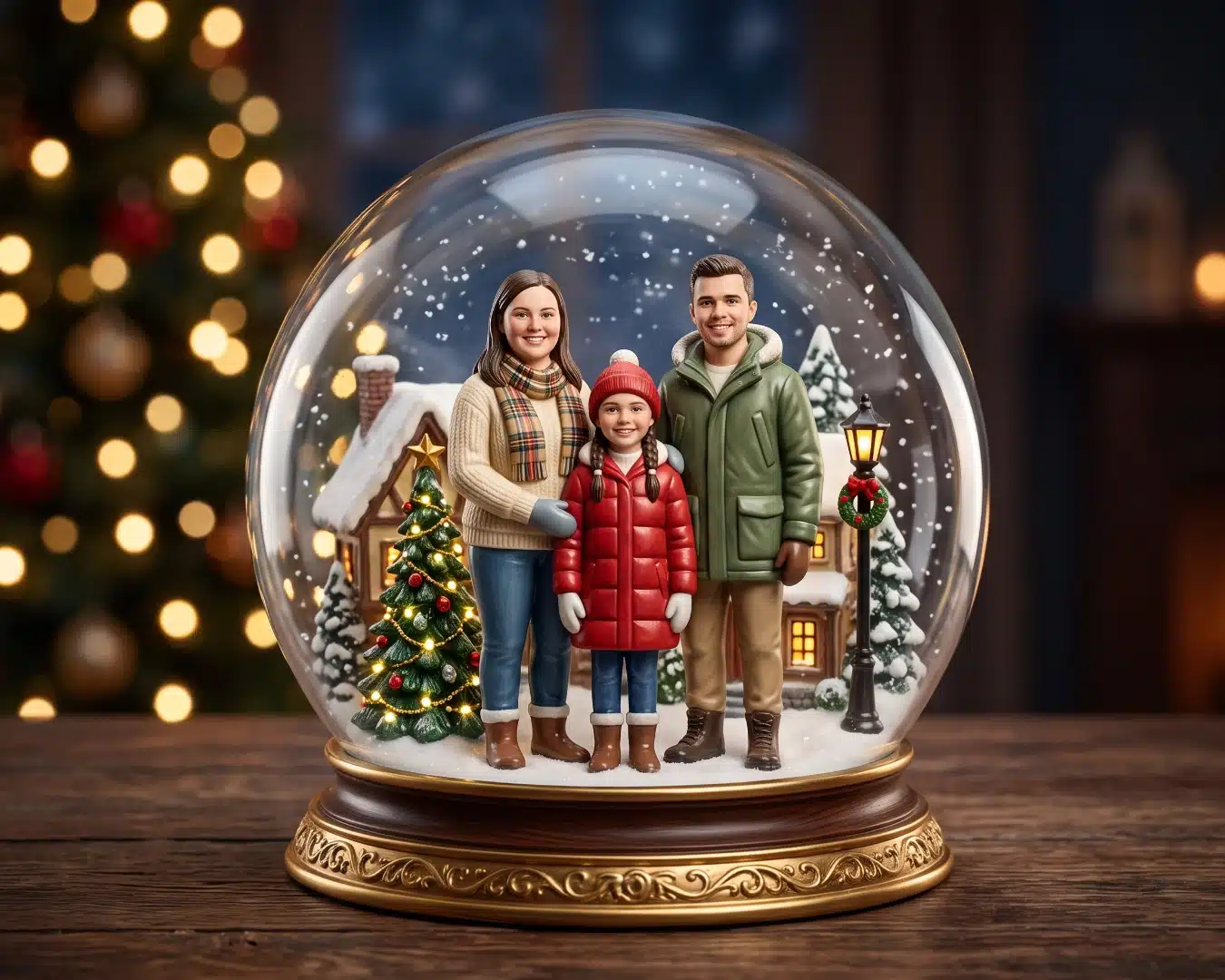
An honest three-way comparison of traditional photo booths, commercial AI booths, and directed photo booth experience from over a decade of running all three.

A few years ago I was doing real estate photography for a Hudson Valley realtor. She was listing a home for a family whose daughter I'd photographed almost fifteen years earlier — a little girl in a purple fairy costume, looking into a jar for a pixie that wasn't really there.
That photo was still framed in her old childhood bedroom. She was in college by then. Her parents had kept it on the wall for fourteen years, in the room she'd grown up in and moved out of.
That's when I understood what I'd actually been building since 2012. Not photo booths. Not prints. Memories that outlast the paper they're printed on.
I've been running photo booths across the Hudson Valley for over a decade. Weddings. Fundraisers. Corporate holiday parties. Chamber events. Photo fundraisers at Bethel Woods and The Kartrite. A couple of years ago I decided to add AI to the lineup, and I tried every commercial AI booth I could get my hands on. Every one of them failed at real events. So I built my own.
This article is an honest three-way comparison. Traditional booths, commercial AI booths, and the directed-experience booth I built. Not because I want to trash the competition. Because if you're planning a wedding or a fundraiser or a corporate event, you deserve to know what you're actually paying for — and what your guests are going to walk away with.
The three don't do the same thing. And the money you spend on the wrong one is money your guests never see turn into a memory.
Before I compare anything, I want to make sure we're comparing the same things. Because a lot of the confusion in this category comes from vendors selling three different products under the same label.
A traditional photo booth is the classic setup. Enclosed booth or open-air backdrop, a prop table, a strip printer that outputs 2×6 photo strips. Guests walk in, grab a boa or novelty glasses, pose for 3–4 shots, and walk out with a paper strip. The tech hasn't fundamentally changed in twenty years. What has changed is the styling — mirror booths, glam booths, ring lights — but the mechanic is the same.
A commercial AI photo booth is what most of the industry started shipping in 2023–2024. Guest walks up to a screen, poses, gets photographed against a green screen or clean backdrop. Software then transforms the photo using generative AI — puts you in Renaissance clothing, makes you look like a movie poster, restyles you as an 80s rock star. Output is usually a 4×6 print. The AI processing takes 30 to 60 seconds per photo, sometimes longer at load. That processing time is where most of these platforms fall apart at real events.
A directed photo booth experience is what I've been building. Not renting somebody else's booth software. Software I wrote, running on kiosks I designed, delivering a specific kind of moment I'd been perfecting by hand since 2012. The guest picks a theme from over 120 options. The software directs them into a pose that matches. The AI transforms them into that theme — up to 6 people in one frame, all recognizable. Head-counting software prints one 4×6 for each person in the group. Every guest walks away with their own copy.
Three different products. Three different price points. Three different outcomes. Everything below is what you actually get for what you actually pay.
Speed matters, but not in the way most vendors talk about it.
Traditional booth: 8 to 10 seconds from final shot to print out. Dye-sublimation printers like the industry-standard DNP RX1 hit about 12 seconds per 4×6, and photo strips run a couple seconds faster.
Commercial AI booth: Vendors publish 30 to 60 seconds of AI processing per photo. That's the spec-sheet number — what a single generation takes when the queue is empty. At load with a full line — which is what happens at any event worth booking a booth for — that number balloons to 1 to 2 minutes per photo. I know this because I operated the software at real events.
Foto Transform AI: 27 seconds average generation time, at load, with a full line — measured and logged by my software at my last event. That's not a best-case theoretical number. That's what my software actually delivers during exactly the operating condition where commercial AI fails.
So on raw speed for a single photo, traditional wins because there's no compute in the way. But between commercial AI and Foto Transform AI at the operating condition that actually matters — a full line at load — Foto Transform AI runs 3 to 4 times the effective speed.
That's not a marketing claim. That's what my software logged at my last event.
This is where the commercial AI category collapses, and where the argument for what I built starts making sense.
According to Majestic Photo Booth's operational data, a traditional booth handles about 30 to 35 sessions per hour sustained, up to 40 in short bursts. Their exact words: "You cannot hold that for four hours." So a 4-hour wedding delivers roughly 130 sessions. At 2 strips per session (the industry standard confirmed by Limelight Entertainment NJ, Pics Booth, and every other vendor I checked), that's around 260 total prints delivered.
Commercial AI is where the wheels come off. On every mainstream commercial AI booth I operated, the software runs a single-queue processing pipeline. Guest 1's photo takes 30 to 60 seconds to process. Guest 2 can't start browsing themes at the booth until guest 1 clears. Their browsing time and the processing time run back-to-back instead of concurrently.
At load, that stacks fast. By guest 10, you're waiting 8 to 17 minutes just to reach the front of the line. Guests can do this math themselves. They look at the line, they see how slow it's moving, they leave. On a 4-hour, 200-guest wedding, I've watched commercial AI booths deliver 50 sessions if we were lucky. Most of the guests never got their photo.
That failure isn't fixable with better AI. I know because I tried. At a haunted attraction I was operating one season, I brought in a second computer and ran a second instance of the commercial AI software in parallel, hoping to double throughput. Each instance still ran its own single queue. Guests still stacked up serially inside each one. The line still dissolved. I paid for twice the hardware and got the same failure at scale.
Foto Transform AI runs every stage in parallel. Theme browsing at the booth kiosk happens during the previous guest's AI processing. Generation runs in the background while the guest walks to the delivery kiosk. Delivery happens at a station separate from capture. Nothing waits on anything else in the pipeline. Effective booth-blocking time per guest: 5 to 10 seconds of capture, plus their own concurrent browse. On a 4-hour event, I deliver about 100 to 130 sessions — same as a traditional booth, but with AI transformation on every one.
One more thing about the architecture worth naming. Foto Transform AI's parallel processing capacity scales as the platform's demand grows. As I take on larger events — corporate brand activations, multi-day conventions, larger-scale weddings — the software increases its concurrent processing capacity to match. That's not a version bump or a code change. It's built into how the platform provisions AI capacity per event. Which means the 27-second-at-load number I measured at my last event isn't a ceiling. It's what my software delivers today, at today's demand levels, and the platform is designed to hold that number as demand scales up rather than degrading under load the way commercial AI booths do.
The difference isn't speed. It's what the software is doing while it waits.
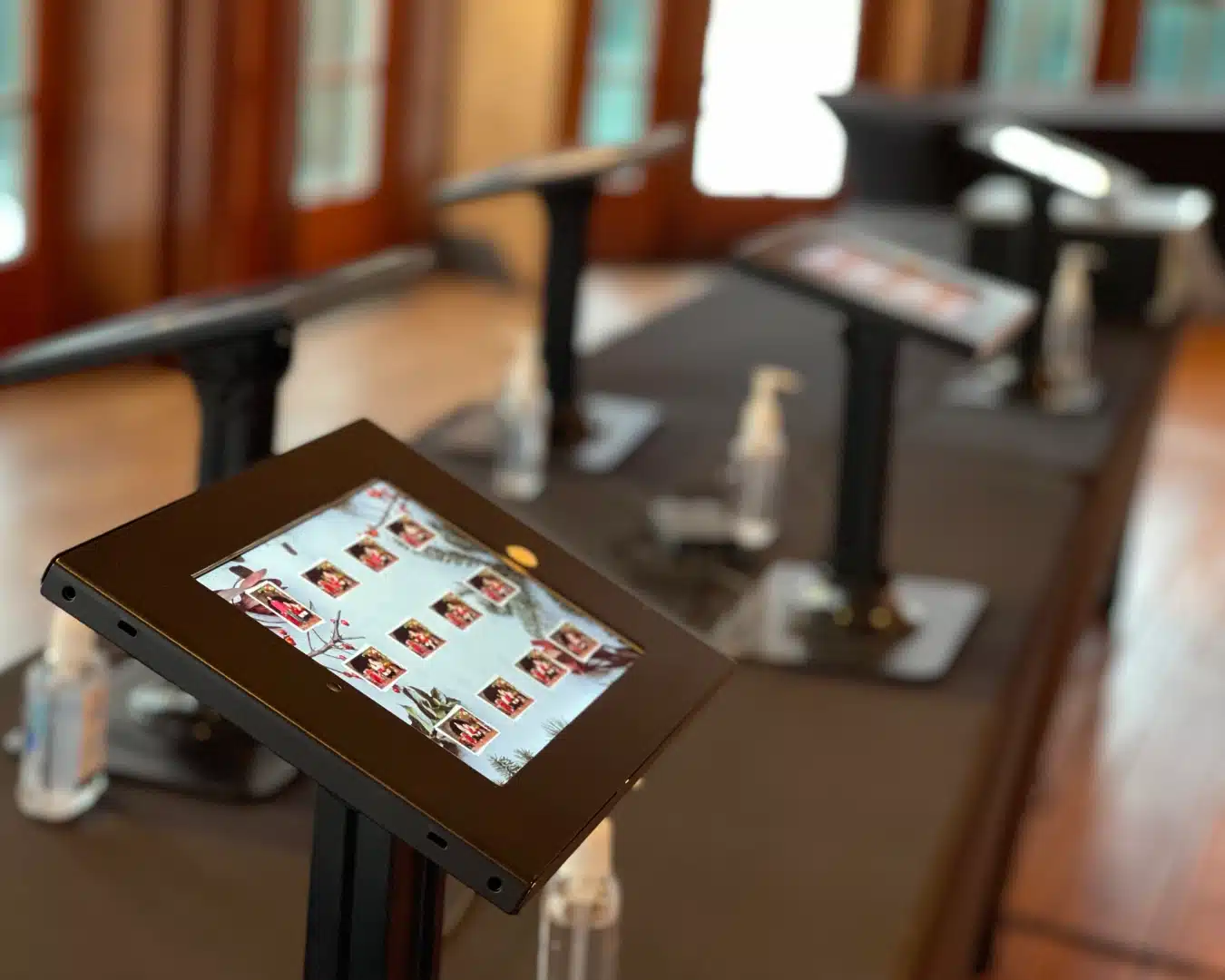
A photo booth is a group product. Weddings, corporate parties, galas, bat mitzvahs, sweet sixteens, brand activations — every event I've ever worked revolves around groups of people wanting to be photographed together. Bridesmaids. Cousins. The bride's college friends who flew in from three states. Coworkers who don't see each other much anymore.
Traditional booths handle groups fine. Six people squeeze in, everybody makes a face, the strip prints. Two decades of standard practice.
Commercial AI booths handle groups badly, and the failure mode is architectural. The mainstream commercial AI booth software runs a two-stage pipeline: first a generative AI scene is produced, then a face swap happens as the final step. The scene generation invents hallucinated figures at hallucinated positions with hallucinated poses. The face-swap step then tries to paste the guest's real face onto one of those hallucinated figures.
At one person, that mostly works. The model invented one figure, the software swaps in one face, the result is passable.
At groups of four or six, the pipeline compounds against itself. The generative model produces four or six hallucinated figures whose bodies, positions, and poses were never designed to receive the guests' actual faces. The face-swap step then tries to solve a matching problem it wasn't built for. Which of four bridesmaids' real faces goes on which of four hallucinated bodies?
The answer is usually a scramble. Faces land on the wrong bodies. Faces duplicate. Faces vanish. The four bridesmaids look at the print and can't find themselves in it. Some commercial platforms ship a few themes marketed as "group friendly" (usually stylized aesthetics like Renaissance court where the theme can absorb some face-swap variance), but even those are a quality gamble. As an operator you can't preview the result before generating it, and if it comes out wrong, you can't reprint efficiently on a single-queue system that's already dissolving lines behind you.
Foto Transform AI transforms up to 6 people in one capture, into the same theme, all recognizable. Every face is attached to the right body. Same pose you held in real life. Same expressions.
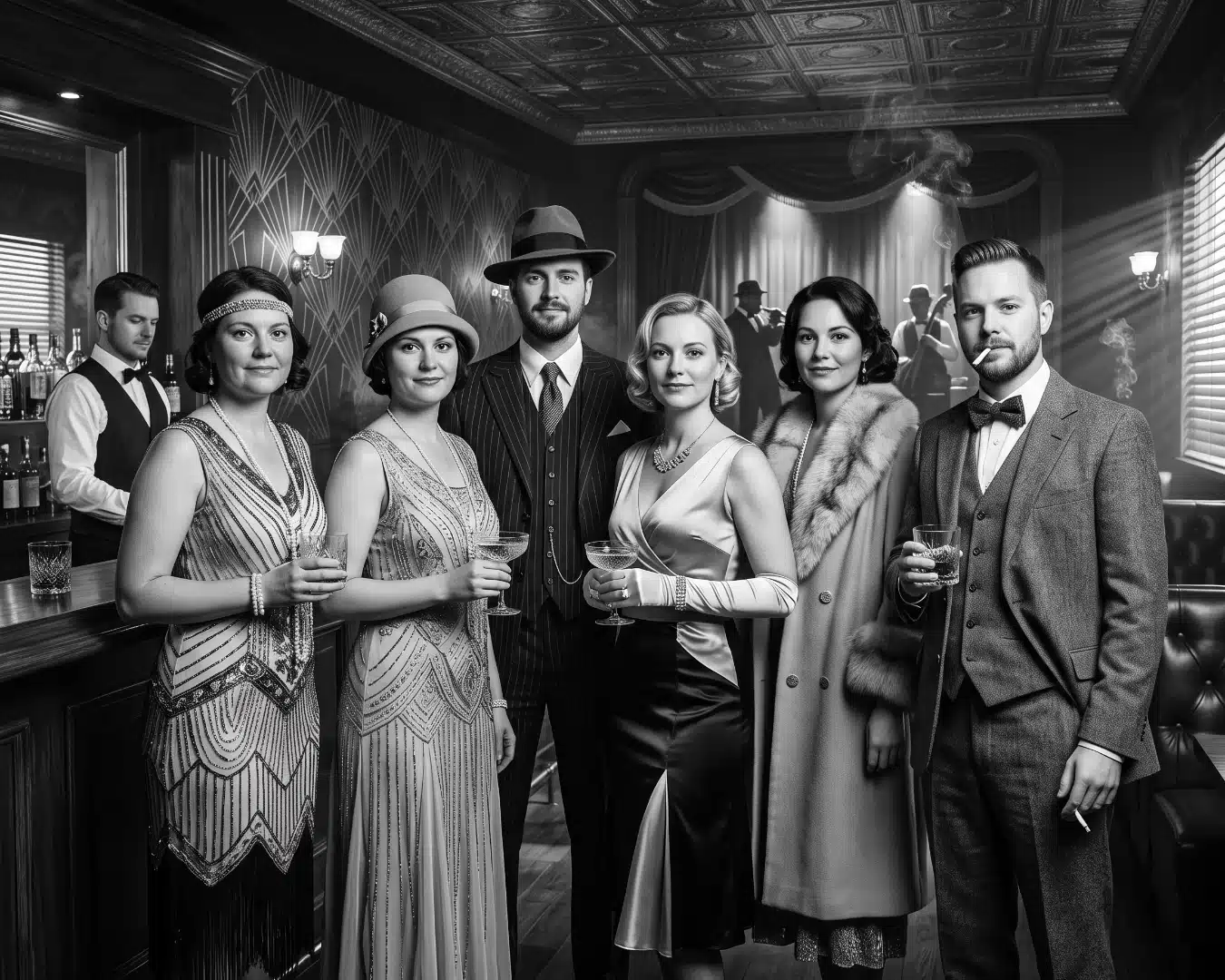
One more thing about groups that operators will recognize immediately. AI is probabilistic — sometimes it produces a result that doesn't work. Face swap comes out wrong. Composition breaks. Or the AI's own content policies reject the combination (kid's face on a horror-themed scene, for instance). Commercial AI booths hand the broken result to the guest, or produce nothing, and the guest walks away disappointed. Foto Transform AI shows the result to the operator first. If it's off, the operator regenerates the same theme or picks a different one — without ever pulling the group back into the booth. The guests are already at the delivery kiosk or the bar. They never see the first attempt. What they see is a print that works.
That's what a photo booth is fundamentally for. It's how the industry has always worked. Commercial AI didn't design their software around it — they designed it for single selfies and shipped the same code to weddings.
Here's a difference nobody in the industry talks about because it's baked into their gear and they can't fix it.
Traditional photo booths print two strips per session. That's the industry default. Limelight Entertainment NJ publishes it on their FAQ: "Normally with any of our photo booth rental packages you will receive two photo prints per session." Pics Booth advertises "two individual 2×6 prints per session." LA Photo Booth Rentals sells "Double Prints" as a $75 paid upgrade, which is proof by market pricing that two strips is the default.
Two strips per session works fine for a couple. It breaks for a group of four. Somebody doesn't get one. Usually two somebodies. The four bridesmaids leave with two strips split among them, and the other two are asking the ones who got them to text them a photo of the strip the next morning.
Commercial AI is worse. Because most themes only transform one face and output one 4×6, the entire group is watching one person get their AI photo. The others get nothing.
Foto Transform AI counts heads. A group of 4 gets 4 identical 4×6 prints. A group of 6 gets 6 identical 4×6 prints. Same photo, same theme, same faces attached to the same bodies as reality — six copies of the same moment, one on each fridge Monday morning.
That last part matters. If the experience is the product and the print is what brings it back — the whole thesis of this article — then the print only works for the person holding it. A traditional booth artificially limits how many people can leave with the trigger. A commercial AI booth doesn't even try. My software makes sure every person who was in the memory gets their own version of it.
The fairy photo I opened this article with? One kid. One parent. One print. That was enough because it was one family. But a wedding isn't one family. It's 200 people who each want their own version of the memory to find in a drawer in 2040.
Photo booth vendors have been selling prints for twenty years. Better paper. Custom borders. Layflat albums. Digital delivery. Boomerangs. GIFs. The industry has treated the print as the product and the experience as whatever happens while the print gets made.
I've been running it backwards since 2012.
The experience is the product. What happens to the guest between walking up and walking away — the direction, the pose, the reveal — that's what they're paying for. The print is a trigger. Twenty years from now they don't remember the print. They remember what the print reminds them of.
So the print's job isn't to be pretty. Its job is to be an accurate trigger for a feeling worth reactivating decades later.

Before AI existed, I ran a children's experience called The Magical Faerie Experience. Kids in fairy costumes, in an enchanted forest set. But the whole point was direction.
I'd hand a kid an empty glass jar with a flash hidden inside it, and tell her to look for the pixies. When she leaned in, believing something was in there, the hidden flash fired at the moment I pressed the shutter. In the final print, a glowing pixie appeared in the jar. On the shot above, the flash was hidden inside a lotus flower on the water — she was told to watch and see what happened. The light on her face is real. The composited world around her is what I built later. What she experienced was pure direction. Guide the child into a moment of belief, capture it, deliver the payoff.

Twenty years from now, the girl in that lotus photo won't remember the paper. She won't remember the flash. She'll remember the feeling of being four years old and believing there was a fairy in the lotus. That's the memory the print reactivates. That's the product.
Fast forward. Sullivan County Chamber of Commerce Young Professionals event at Bethel Woods Center for the Arts. Adults, at a business networking function. I ran a virtual-background booth where I picked the backdrop before each group and directed them into it.
"Imagine you're on a New York subway platform right now. A train's about to pass behind you."
The whole group threw their arms up, braced like commuters, reacted to the imaginary train's noise. When I snapped the photo, the virtual background dropped them onto a real subway platform with a train blurring past. They saw themselves standing there — laughing at each other for having bought in.
Same technique, different scale, older audience. What that group remembers isn't the virtual background. It's the feeling of being at a chamber event and committing to being subway commuters together for thirty seconds. That's the memory. The print is what brings it back.
Foto Transform AI is that technique in software. Every theme in the library — over 120 of them — has posing instructions built into the booth kiosk. The guest picks their theme first. Then the software tells them how to pose for it. "Look mean. Pretend you're holding a rifle." "Throw your arms up like you're bracing for the subway train." "Look out over the crowd like you're headlining the arena."
The guest picks the theme, so they know what's coming. That means the surprise isn't the theme. The surprise is seeing themselves in it. Nobody has ever seen their own face as an 1800s outlaw. Nobody has ever seen their own face on a Renaissance throne. The pose is theirs, the face is theirs, but the world around them is one they've never inhabited. That's an identity surprise, and it hits every single guest, every single time. The 200th guest at a wedding gets the same jolt as the first.
What The Magical Faerie Experience did one child at a time with a glass jar, Foto Transform AI does at throughput because the direction is in the software. Nobody has to stand at every kiosk telling every guest how to pose. The screen does it. That's what makes it scale past what any single attendant could sustain.
Every other booth on the market is selling paper. I've been selling the feeling that comes back when you find that paper in a drawer twenty years later.
Foto Transform AI's Activation tier includes custom themes designed for the event. Not filters slapped on top of a generic theme library — full themes built around the event's identity, brand, story, aesthetic. A wedding themed around the couple's shared love of a specific decade. A corporate holiday party themed around the company's product line. A brand activation themed around the campaign creative.
Traditional booths can't do this because they have no software layer to theme. Commercial AI booths let you create your own theme too — but through a basic prompt field that accepts 1 to 3 sentences of text. That's not a custom theme. That's a text-to-image prompt. What you get back is whatever the underlying AI model produces from those sentences, with no directed posing instructions built in, no tuning for the reveal moment, and the same face-swap failure mode at group size that plagues every other theme in their library.
Foto Transform AI's custom themes are designed the way I've been directing photo booth experiences since 2012 — with the pose the guest holds, the moment of belief they experience, and the reveal they walk away with all built into the theme before it goes live. The 1-to-3-sentence prompt box isn't in the same category.
Here's what most operators would never think to build. My software tracks which themes guests actually pick at every event, categorized by event type. Weddings pick different themes than corporate parties. Bar mitzvahs pick different themes than fundraisers. As I run more events, that data compounds into intelligence about what actually resonates at each event type. When I plan a booth for your event, I'm not guessing which themes to feature — I know what your event type responds to.
The mainstream commercial AI booth software tracks number of generations, because that's what they bill on. It doesn't track which themes guests actually chose. Not because they can't — it's simple to log — but because the data doesn't matter to their business. Their theme libraries are curated by their marketing team, not by operator event data.
The reason I built theme-choice tracking into Foto Transform AI is the same reason every architectural decision on the platform got made: the experience is the product. If the experience is what I'm selling, I need to know what makes it land for whom. The commercial category isn't tracking it because they're not selling the experience — they're selling generations. Their software captures what they charge for. Mine captures what I care about.
The Activation tier at $2,200 for a 4-hour event is where clients who care about brand alignment book. Corporate holiday parties. Product launches. Weddings where the couple wants their guests to see themselves as characters from a story that matters to them. Custom themes beyond the package are $350 each.
You've been reading a long article. Here's the arithmetic that closes it.
I'm using a 4-hour, 200-guest wedding as the reference event. Everything below is grounded in published 2026 industry pricing plus my own operator data — captured by software that logs its own performance, not estimated from memory.
| Traditional Booth | Commercial AI Booth | Foto Transform AI Essential | |
|---|---|---|---|
| Print format | 2×6 photo strip | 4×6 single image | 4×6 single image |
| Rental price | $700–$1,500 | $1,995–$3,200 | $1,050 |
| People transformed per session | Whole group | 1 individual only | Up to 6, all recognizable |
| Prints per session | 2 strips | 1 print (to the transformed guest) | 1 per person via head-count |
| Sessions delivered | ~130 | ~50 (line dissolves at load) | ~264 |
| Total prints delivered | ~260 strips | ~50 prints | ~417 prints |
| Cost per print | $4.23 | $50.00 | $2.52 |
| Guests with their own copy | ~55% | ~15–20% | ~100% |
| Cost per guest served | $8.46 | $50–$100+ | $6.56 |
Sources. Traditional booth pricing: Bark 2026, Pixilated 2026, ThePerfectWedding.com 2026, EventBrothers 2026. Commercial AI booth pricing: Captured Celebrations LA 2026, PhotoboothTO 2026, Pons.ai 2026, PIKSHR.PRO 2026. Session throughput: Majestic Photo Booth 2026, Time Into Pixels 2026. Print format standards: Limelight Entertainment NJ, Pics Booth. Foto Transform AI pricing: nimbledragonstudios.com/ai-photo-booth-rental-hudson-valley. Commercial AI processing time and single-queue architecture failure: firsthand operator observation, unpublished.
How I Know These Numbers
Foto Transform AI's platform logs every generation, every print, every session, every theme selection, and every error at the software level. When I say "263 prints on 166 generations across 2.5 active hours," I'm not remembering — I'm reading the log from my last event. Every event I've run on my own platform has a granular metrics record I can pull up on demand. Which means the throughput and cost numbers in this article aren't modeled from industry averages. They're extrapolated from actual event data that the software captured while it was happening.
The commercial AI booth vendors don't publish equivalent data at the per-event level. If they did, the queue-dissolution failure at load would be quantified across every event on every platform — and it would end the argument. My guess for why they don't is that they've looked at their own data and decided prospects don't need to see it. My software captures the same data and I'm happy to show it, because on my platform the numbers make the case.
Reference event for the numbers above: a 3-hour booking with 2.5 active hours of run time (the client had other programming happening around the booth), one kiosk. 166 generations, 263 prints delivered, 1.58 prints per generation average — a typical mix of solo captures and small groups. Extrapolated to a 4-hour reference event at the same pace: ~264 generations, ~417 prints on a single kiosk.
Look at the middle column of the table. That's what commercial AI actually delivers at scale. It's not that the vendors are overpricing — $1,995 to $3,200 for a 4-hour wedding is in line with what the market is charging for AI booths. The problem is what you get for the money. Fifteen to twenty percent of your guests walk away with their own print. Fifty dollars per print delivered. That's not a photo booth. That's a single-person AI selfie kiosk rented at photo booth prices.
Traditional booths look reasonable on this table. But look at the coverage number: fifty-five percent of your guests get their own copy. The rest are asking whoever grabbed the strip to text them a picture of it the next morning. And a lot of those texts never happen.
Now look at the right column. My Essential package is $1,050 for 3 hours. That's inside the traditional booth's price range. And it delivers a lower cost per print, at higher fidelity (4×6 vs 2×6 strips), while getting every single guest their own copy. That's not marketing. That's arithmetic.
That table shows Essential. It doesn't show what happens at Signature.
Signature is $1,600 for a 4-hour event and includes the Remix Station — essentially a second booth, no new photo required. The capture booth stays fast with 8 curated themes so the line keeps moving. The Remix Station opens the full library of 120+ themes and runs as an independent print line: a guest picks a theme, transforms their captured photo into that theme, and prints, emails, or texts it right there. Once a guest has been through the capture booth once, they never wait in that line again — the Remix Station handles every return visit, running in parallel to the main booth. Same original capture, different world. Then a third world. Same wedding, three different versions of who each guest got to be.
The math on Signature is the one that makes people stop scrolling.
At an average of 60% of guests using Remix once and 30% using it twice, a Signature event delivers around 740 prints — original captures plus restyles. Cost per print drops to about $2.16. That's the lowest cost per print in the entire category. Cheaper than a traditional booth's 2×6 strips. Cheaper than any AI booth on the market.
If you've run a booth, that number probably looks high. A typical 4-hour wedding produces 150-200 prints at a traditional booth or a single-line commercial AI booth — one print per capture, one capture per group, everybody in the group shares. Signature produces four to five times that because the math changes at the mechanical level: every person in a group gets their own print (not one strip shared), and the Remix Station adds a second print line that runs independently of the capture booth. It's not the same product delivering more. It's a structurally different product architecture.
Those return-visit rates aren't arbitrary. The Remix Station is architected to reward return visits — every remixed print circulates the reception, and every print that circulates becomes an invitation for another guest to try a theme they hadn't seen yet. That's the mechanic underneath the math.
Not because I cut corners. Because I multiplied what one capture produces.
Depends on what your event is, and what you want your guests to walk away with.
Book a traditional booth if:
Book a commercial AI booth if:
Book Foto Transform AI if:
For fundraisers specifically, the math changes further because Foto Transform AI can run as a dedicated fundraising line item at your event — clients have raised significant sums in a single night by turning the booth into a giving station.
I want to close with the story that made me stop trying to make commercial AI work at scale, because it's the reason Foto Transform AI exists.
I was operating one of the mainstream commercial AI booth platforms at a haunted attraction. Guests were paying $20 for a 4×6 print and $30 for an 8×10 — and a good percentage were buying multiple themes. Every session was direct income. Every abandonment was a check that never got cut.
But the money isn't why I built my own. The joy on guests' faces when they saw their transformation is what made me seriously consider finding a solution to the AI problem. The demand was real. The product was real. Guests wanted what the AI could deliver and were happy to pay for it. The only thing standing between them and the memory was software that couldn't keep up with the line.
The first few weekends of the season went fine. Small crowds, short lines, the software kept up.
There was a second problem I'd been managing all season, separate from the queue. Zombie themes — the ones guests were most excited about at a haunted attraction — kept getting flagged by the commercial software's content policy and refused mid-generation. My workaround was making every group pick a backup theme up front, in case their first choice got rejected. Which it usually did. Guests came for zombies and left as vampires. Same problem as the queue: the software wasn't designed for the event it was serving.
Then October hit and the audience built the way haunted attractions build — word of mouth, weekend by weekend, until the last three weeks are the entire year's revenue. That's when the queue architecture failed.
Guests who'd already captured were waiting five, ten, fifteen minutes for the AI to process their photo. New guests were watching a line that visibly wasn't moving. And they started leaving. Not from the back of the line. From after they'd captured. The ones who had already waited twenty minutes to reach the front, put in their theme, taken their photo, and then realized they had to wait another ten minutes to see the result. They walked away. Some of them never got their photo at all.
Every abandonment was money I never collected.
So I did the obvious thing. I brought in a second computer and ran a second instance of the AI software in parallel, hoping to split the queue and double throughput. It didn't work. The software's architecture didn't care that I'd doubled the hardware. Each instance still ran its own single queue. Guests still stacked up serially inside each instance. The line still dissolved. I paid for twice the compute and got the same failure at scale.
That's when I understood the problem wasn't the AI or the hardware. The software was designed to process one photo at a time inside each instance, and no amount of parallel hardware could retrofit around that design. The only fix was rewriting the software.
Foto Transform AI's parallel pipeline exists because I sat in the middle of that haunted attraction, watching my second computer run at full capacity while guests still walked away from the line, and knew the only path forward was to build it myself. Every stage of Foto Transform AI runs concurrently by design — theme browsing, capture, AI generation, delivery, Remix Station. No guest ever waits behind another guest's cycle inside the same instance, because there is no serial cycle to wait behind. The failure I lost money to on that October run is architecturally impossible on the platform I built.
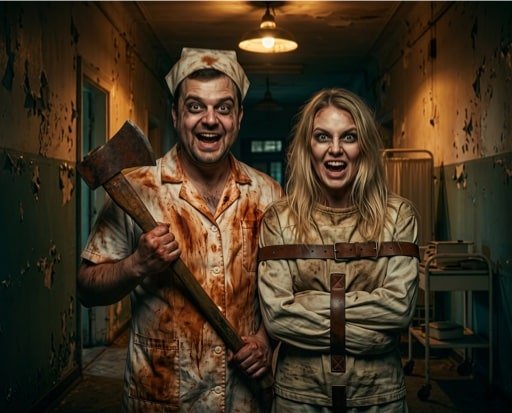
Below: haunted themes I built on Foto Transform AI. The same aesthetics commercial software refused to generate, rendered clean.
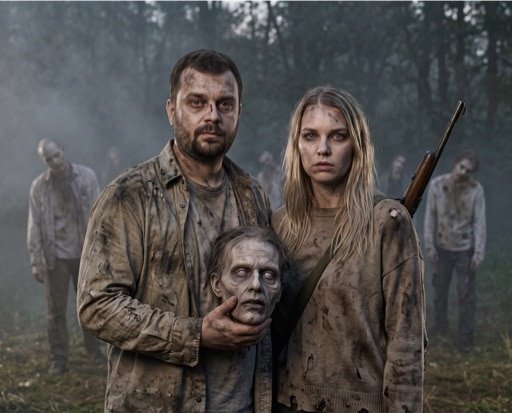
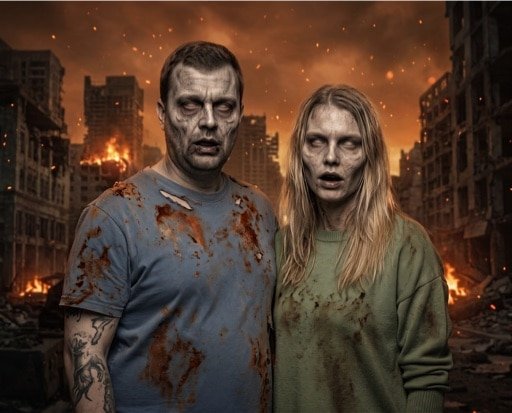
If you want the deeper technical breakdown of what commercial AI vendors won't tell you about their software, I wrote a whole piece on that: Why We Built Our Own AI Photo Booth. It walks through the ten questions to ask any AI photo booth vendor before you book.
Ready to see what a directed AI photo booth experience looks like at your event? Explore Foto Transform AI, browse packages for the Hudson Valley, or set it up as a fundraising line item.